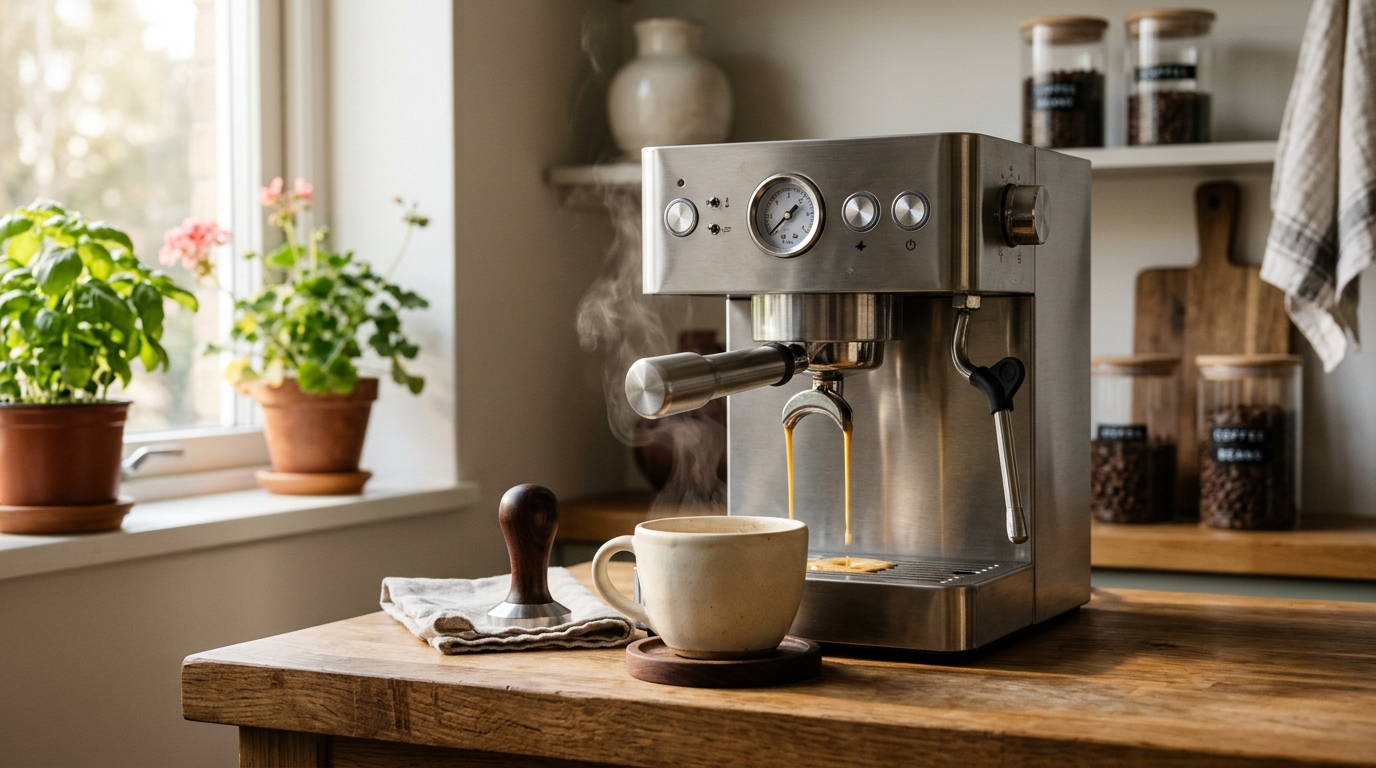
Compare compact PID thermoblock espresso machines under 10 inches wide for fast 3-second heat-up, real 9-bar extraction, and silky microfoam.
In this article
You do not need a 25-kilogram Italian dual-boiler monument—or a 30-minute morning preheat wait—to pull rich, syrupy espresso and pour silky microfoam lattes before your 9 a.m. meeting. Modern compact PID thermoblock machines heat up in under ten seconds, occupy less than eight inches of apartment counter width, and save daily café drinkers well over $1,100 per year.
Top Compact Espresso Machines Compared
| Model / Option | Best For | Key Verified Specs | Typical Price Range | Key Trade-off | Check Price |
|---|---|---|---|---|---|
| Breville Bambino Plus | Daily latte & cappuccino drinkers in compact kitchens | 7.7 inches wide; 3-second ThermoJet heaterDigital PID + 9-bar OPV + 3-way solenoid valveAutomatic milk-temp sensor + manual steam mode | $449 – $499 | + Instant morning heat-up and dry, easy-to-knock coffee pucksAuto microfoam wand delivers café texture hands-free on busy morningsLarger 1.9L water tank than the standard Bambino − Uses 54mm portafilter instead of commercial 58mm accessories | Check on Amazon |
| Breville Bambino (Standard) | Smart-budget home baristas pairing with a $200 burr grinder | 7.7 inches wide; same 3-second PID ThermoJetSingle-wall & dual-wall 54mm baskets includedFull manual articulating steam wand | $299 | + Identical espresso extraction quality to the Plus for $200 lessLeaves budget room for a proper conical burr grinderTiny 12.6-inch depth fits under low apartment cabinets − No 3-way solenoid valve (wait 10 seconds before unlocking portafilter) | Check on Amazon |
| Flair Pro 3 (Manual Lever) | Pure espresso purists, travellers & minimalist apartments | Zero electronics, zero pumps—pure manual leverBuilt-in pressure gauge for 6–9 bar profilingPacks flat into a padded travel carrying case | $325 | + Virtually indestructible; pulls café-rivaling light-roast shotsSilent morning ritual with zero pump vibrationZero descaling headaches or circuit boards to fail − Requires a separate gooseneck kettle and milk frother for lattes | Check on Amazon |
Why “20-Bar Pump” Stickers Are a Marketing Trap
Walk down any appliance aisle and you will see $99 machines shouting “20-BAR PROFESSIONAL PRESSURE!” in giant gold lettering. In reality, authentic espresso is extracted at 9 bars of pressure (and modern specialty baristas often pull even sweeter shots at 6 to 8 bars). High 15-to-20-bar vibration pumps without a calibrated Over-Pressure Valve (OPV) blast water through the coffee puck too violently, causing channeling and harsh, bitter astringency.
Both Breville Bambino models include a factory-calibrated 9-bar OPV and low-pressure pre-infusion—two features rarely found under $500.
Essential Accessories Worth Buying (And What to Skip)
- Worth buying: A $15 digital 0.1g coffee scale with timer (target 18g dry coffee in → 36g liquid espresso out in 27–32 seconds), a WDT needle distribution tool ($12) to break up clumps, and freshly roasted whole beans with a roast date printed on the bag.
- Skip at first: Expensive $90 distribution pucks, custom walnut handles, and knock-off portafilters—master grind size and dose consistency first.
Pros & Cons of Compact Thermoblock Machines
✓ What We Like (Pros)
- Ready to brew in 3 seconds—no leaving a boiler running for 25 minutes
- Fits comfortably alongside a burr grinder on a 16-inch strip of counter
- Saves over $1,000/year for daily specialty latte drinkers while tasting fresher than drive-thru chains
✕ What to Watch Out For (Cons)
- Lighter aluminum/stainless chassis means you should hold the machine with one hand while locking the portafilter
- Narrow internal water passages require filtered water and regular descaling
Final Verdict
If you drink milk beverages every morning and love push-button convenience, the Breville Bambino Plus is worth every penny. If you want maximum flavor per dollar, pair the $299 Breville Bambino with a Baratza Encore ESP grinder—it is the single highest-value home espresso combination you can fit in a small kitchen.
Frequently Asked Questions
Why does my grinder matter more than buying a more expensive espresso machine?
Espresso requires uniform, ultra-fine coffee particles to create steady 9-bar resistance. A $200 conical burr grinder paired with a $300 PID espresso machine consistently outperforms a $1,000 machine fed pre-ground coffee.
What is a PID controller and why should I insist on one?
A PID (Proportional-Integral-Derivative) digital temperature controller holds brew water within 1°C of 93°C, preventing sour under-extracted shots and bitter scorched shots.
How much counter width do compact espresso machines actually need?
True compact machines like the Breville Bambino and De'Longhi Dedica Maestro measure just 6 to 7.7 inches wide—leaving room for a burr grinder even in an apartment kitchenette.
What is the difference between a pressurized (dual-wall) and non-pressurized (single-wall) basket?
Pressurized dual-wall baskets have a tiny pinhole underneath that forces artificial crema from coarse pre-ground supermarket coffee. Single-wall baskets require a real espresso burr grinder, but produce dramatically sweeter, richer café-grade shots.
How often should I descale a compact thermoblock espresso machine?
Depending on your tap water hardness, descale every 2 to 3 months using citric-acid or lactic-acid descaling solution—and use filtered low-mineral water to prevent scale buildup inside narrow ThermoJet channels.
How long does it take to break even compared to buying daily café lattes?
At $5.50 per café latte five days a week ($1,430/year), a $500 home espresso + burr grinder setup paired with fresh specialty beans ($0.85/cup) pays for itself in under 5 months.